Blog for Sofia Quintero aka Black Artemis. Ivy League homegirl. Novelist. Filmmaker. Cultural activist. Part-time comedienne. Media literacy maverick, Urban goddess. Unapologetic dilettante. Cancer warrioress.
At the start of every New Year, I develop my curriculum for the School of Life. After I have reflecting on my previous year and setting goals for the upcoming one, I make a list of books, films, software, workshops and other media that might help me toward achieving them.Finally, I prioritize about ten to twelve and aim to complete them at a pace of one per month. Although I’m particularly fond of self-help/workbooks – those that assign tasks, contain questionnaires, etc. – I sometimes include novels, sacred texts and other kinds of literature that might be inspirational. Some books might be holdovers from the previous year, and some books I occasionally reread.Here are some additions to my SOL curriculum for 2012.
Once upon a time, I use to perform standup comedy. I often miss it and hope one day to give it another whirl. While that’s not a priority for me in 2012, becoming better at staying the present and saying, “Yes,” more frequently are. I can’t imagine a more fun way to do that than through the practice of improvisation.Plus, I get to build my comedic chops and lay the groundwork for my return to standup.
One of the books on my 2011 curriculum was a guided journal called Exploring Your Sexual Self by Joan Mazza. I made some discoveries that lead to more questions. Which of my desires were authentic? What can I do to fulfill them in ways that feel safe? And why the hell is this so hard anyway?In the nick of time, Jaclyn Friedman has written an affirming and interactive book that will motivate me to answer these questions and take (not to mention get) action on my terms whatever they may be.
This is a holdover from last year’s curriculum.Formerly known as The Fire Starter Sessions, this is more than a book. It’s a multimedia course for creative entrepreneurs who want the work that feeds the soul to also pay the rent.I recruited two friends to complete The Spark Kit with me. Every week we complete a worksheet and share our discoveries with each other. Because of its holistic approach, my friends and I have also grown closer from doing this together.
As a person who is most comfortable with words, I have been pushing myself to explore other means of creative expression. Wanting to expand my visual sense and satisfy my craving for more physical and tactile activities, I have rediscovered paper crafting and taken up mixed-media art journaling. Enter The Right-Brain Business Plan, a guide to creatively process and document the insights and plans that come to light after I finish The Spark Kit.
Last year I tried to read A Course in Miracles, attempting to do one lesson each day. I didn’t make through January, and whatever I had done, I didn’t grasp at all. But for some reason, the Course keeps calling me. Perhaps an introduction to its principles from an author described as a mix between Carrie Bradshaw and Marianne Williamson is just what the Ivy League homegirl needs.Whether or not A Course in Miracles suits me, after almost a year of not attending to my spiritual development, I hope reading about Bernstein’s journey will inspire me to get back on track.
Several years ago Suparna Bhasin, creator of She Creates Change, introduced me to a simple practice that improved my life immediately and tremendously: rise at 6AM and bed by 10PM.(I have advocated so much for following circadian rhythms, my MFA classmates sometimes refer to them as Sofia cycles.) Suparna also recommended Deepak Chopra’s Perfect Health, an accessible and practical introduction to Ayurvedic medicine. I learned in 2011 not to take my health granted; 2012 is the time to apply the lessons and develop new, healthy habits.
There was a very long time when I believed that striving to be a social change agent necessitated eschewing material wealth.In recent years I have discarded that thinking, and while I never wanted to be affluent for its own sake, I do keep a mental list of progressive organizations and causes that I fantasize about supporting as a philanthropist.
After hearing her speak at the New York Women’s Foundation luncheon in 2010, Kathy LeMay has become my role model of socially conscious giving and reminded me that no matter what net worth, I always have “time, treasure and talent” to offer. Rather than just donate some dollars here, volunteer a few hours there, this book is a guide toward creating a strategic plan in leveraging my giving so that it truly makes a difference and is aligned with my deepest values.
These are just a few of the resources on my curriculum for this year. These rank high in priority because they are most aligned with the things I have decided to pursue in 2012 at this time. Like any good curriculum, however, it is subject to change according to my needs.Life hands out challenges and opportunities, and as a result, some of my priorities are sure to change.As such I’ll surely discover and add more books, films, classes, coaches, etc. as well as change my mind and remove others as I grow into sharper clarity about what I want and need to be happy.
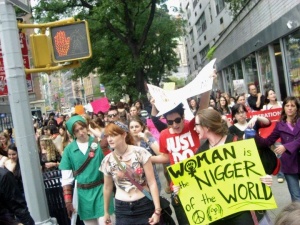
Who spiked the Evian? Lately, there’s been a rash of White women using the n-word – including self-professed liberals and progressives. As if that were not bad enough, they act shocked, defensive and even downright nasty when told by women of all races that they should cut that shit out.
First example: a few White women made and carried signs that stated Woman Is the N***** of the World for Slut Walk in New York City on October 1st.
While some White women including those among Slut Walk NYC's organizers and participants have stepped up to condemn these actions, there are too many who have come to their defense, ranging from the naively privileged to the unapologetically hostile. I’m talking Facebook posts such as, “It is NOT racist, and anybody who thinks so is a fucking idiot” to a White woman telling an African American woman to go fuck herself. (I’d post links, but in no surprise to me, the posts have conveniently disappeared.)
A few days later, Barbara Walters used the word and then played victim when told by her The View co-host Sherri Shepherd that she was hurt by it. Acting as if her journalistic integrity was called into question instead of hearing the pain of her so-called friend, Walters exploited Shepherd’s struggle to concretize her discomfort with Walters’s use of the word and attempted to make Shepherd feel unreasonable for taking offense. (I’ll save my musings on why Walters will never have a woman of color – least of all a woman of African descent – who is capable and willing to hand her ass to her on The View for another time.)
Then last night I learned that at Occupy Philadelphia, two Black women were called n****** by volunteers. Now the actual details of the incident remain sketchy, but from what I understand, the fact that these women were slurred is not in dispute. Apparently, charges of racism against the organizing group predated the incident.
Many women of all races such as Stephanie Gilmore, Sydette Clark and the Crunk Feminist Collective have issued thorough, incisive and poignant analyses as to why it is never appropriate for a self-proclaimed White feminist ally to use this racial slur. There is little more I can add to the substance of these and other responses already made. Still I have a compelling desire (which I will hereinto unapologetically indulge) to contribute to the discussion by making an attempt to make White women perpetrators and their apologists viscerally understand what exactly is the impact of their use of the n-word.
Warning: it ain’t going to be diplomatic or pretty because we’re already far past that.
So to all the White women who think it’s cool to use the n-word, y’all seen the movie Carrie, right? Recall the pivotal scene where Carrie White’s nemesis Chris and her boyfriend Billy dump a bucket of pig’s blood on her. Before Carrie telekinetically wrecks shop, she stands there drenched in blood and humiliation as people laugh at her.
That’s how that shit feels when you use the n-word.
We’re Carrie White and you’re Chris Hargensen except Chris never fronted like she was Carrie’s friend.
A few of your apologists are Sue Snell, perhaps well-meaning but ultimately ineffectual and forever haunted by the damaged to feminist solidarity that you have caused.
But your most virulent apologists are bunch of Billy Nolans who pick up the havoc where you left.
Your use of the n-word is a huge bucket of pig's blood. When you use it and defend yourself, you’re Chris licking her lips as she pulls the cord. It’s a betrayal, plain and simple.
Stop with the defensiveness and rationalizations for just a minute and sit with that. If you're really 'bout it, just accept that already. Recognize that the mere ability to dig your heels in - telling us we don't get it, defending your honor like some damsel in distress (by the way, how are you OK with pulling the most anti-feminist of anti-feminist shticks), etc. - wouldn't exist without the racial privilege you think is somehow neatly tucked away in the folds of your gender identity. You really can’t get whiter than that.
And guess what? Recasting Black women who call you out as the threat to whatever image you have constructed of yourself got you looking really patriarchal right about now. You’re doing to Black women what men of all races to do to us all the time.
It’s a betrayal when you act as if you have no clue in 2011 about what feminists of color endure within our own community when we make the decision to trust in and build with White feminists. Patriarchal men and women of color are like Piper Laurie, doing everything to derail us whenever we align ourselves with you. When we throw on our jackets to head out to the meeting, they stand at the top of the stairs yelling, “They’re going to laugh at you.”
We have faith and show up anyway only for you to pull the cord on prom night.
(Side note to those anti-feminist people of color: now isn’t the time for you to say, “I told you so.” That’s when you go from acting like Carrie’s mother to making like her gym teacher. Instead of joining the laughter, you should be standing with us as we call out the racism rather than using it as an opportunity to gut check us on our feminism. Don’t bother if for no other reason than it’s just not going to work for you. All you do when you attempt to discredit feminism by throwing an instance of racist arrogance of certain White women in our face is play yourself. We’re just not that fickle. With few exception, we’re not going to come “home” like the prodigal Carrie White because, as you'll recall, her mother pretended to comfort her only to literally stabbed her in the back. Yeah, we're not playin' that.)
Now back to you n-word loving White women. You want to show how hip you are? Stop listening to Yoko Ono and Kreayshawn and read a book, read a book, read a MF book. Preferably one by a Black feminist such as Audre Lorde or bell hooks. One course in an entire women’s studies program doesn’t cut it.
What to show how down you are? Quit with the silly references to hip hop culture as some kind of permission. As mad as we may be at you, even we don’t believe you’re that dumb. You especially denigrate yourself with that one so stop it.
To all you Sue Snells, when women associated with your movements ('cause that's what it's looking like right about now - YOUR movements -- now matter how many invitations you extend) tell women of color to go fuck themselves, call us idiots for taking offense, say they’re sorry if we’re offended as if our feelings are the problem and not the actions that triggered them and other such nonsense, how 'bout You. Just. Check. Them. Despite all the historic and ongoing treatment of men of color as menaces to White womanhood, feminists of color usually have no problem pulling a brother’s coattails when he comes for you, but y’all kinda drag your feet when a White woman does the same to us or our men. And that high school tactic of pleading, “It wasn’t me” doesn’t suffice. I don’t mean to get all vanguardist on y’all, but how about you bench these chicks when they come out of pocket? Seriously, where is the discipline in this movement? I’m not saying to immediately show her the door (although that just might be appropriate on occasion.) Struggle with her if you must, but there has to be serious and immediate consequences for racist behavior even if it’s sending homegirl to an intersectionality boot camp.
Stop confusing the fact that the n-word is still used by some black folks as license for you to use it. Many women including White feminists still use the word bitch, but I don't see you abiding for one second any man thinking he can do the same. In fact, if a man who identified as a feminist and/or ally still had the audacity to roll up to Slut Walk with a sign that read Rape is for Pussies, all his professions to solidarity, insistence that we focus on the “real” issue and the like wouldn’t have zilch currency for you so don’t act brand new.
And while we’re on the subject of Black folks who embrace the n-word, I don’t give a damn how many Black friends you have who don’t blink an eye or even think it’s cute when that word comes out of your mouth. You still don’t and never will have license to use that word. Accept that. If you can't stop insisting that you be allowed to use the n-word on philosophical grounds, how 'bout you just let it go on the simple fact that you will never win this one. Trust me on that. If any woman of color - friend, comrade, stranger -- tells you it is offensive to her, the only right answer of a true ally is to knock it off. This mounting any never mind excessive defense of the use of the n-word by you or any other White person then turning around and complaining that our expressing our hurt and anger is a distraction from the "real" issue at hand... how's that working for you? It isn't, and you know it.
And you know why despite your Cool White Chick status you weren’t at the meeting when your Black BFF was elected representative-at-large for the United Black Diaspora? It's because the election never took place and that organization doesn’t exist. They never did and even if they ever were to, despite your CWC bona fides, you still wouldn’t be invited. Trust me on that one, too. Until we make some meaningful progress in defeating racism, White anti-racists have their own lane. You truly want to be an ally? Stay in it.
Yes, this is harsh, but in addition to being furious at the recent number of White women who think they can use this word and still front like they are our friends, I’ve been spoiled. I have meaningful relationships with White feminists who get it, and they have set the bar high. Are they perfect? No. But unlike you, they listen. Perhaps that’s why you avoid them like the plague. If you were genuinely interested in dismantling racism and forgoing the white privilege that would require, you would spend less time on Facebook defending the indefensible and more live time with them.
And for God’s sake, stop watching propaganda like The Help.
Summary: in pursuit of shits and giggles, a man admitted before a live audience that he aggressively pursued sex with a woman who told him repeatedly that she didn’t want him in her home never mind her body. The purpose of said revelation: to inspire other men to improvise a sketch based on this event for even more shits and giggles.
Let someone suggest, however, that rape culture in the United States is alive and well, and heads rush to spew conspiracy theories about humorless feminists.
This happened at an improv festival in New York City. Not in Congo, Iran, Nicaragua or anyone of “those places” we like to turn up our noses and wag our finger at for the atrocious way women are treated. Nope, it happened right here in the good ol’ US of A where a sexual assault survivor has to be damned near perfect if she stands a snowball’s chance in hell of seeing her perpetrator tried by a jury of his peers. Between the acquittal of two police officers for sexual assault (one with a history of being abusive toward women while in uniform) and the dismissal of the rape charges against Dominique Strauss-Kahn (who suspiciously leaves a trail of rape allegations wherever he goes), this damned city is turning into Club Med for predators.
The thing that disturbs me the most about this incident is that the male comics on stage were astute enough to crack jokes about the ethical and legal ramifications of this knucklehead’s behavior, but not a damn one of them was brave enough to call it out explicitly and shut him down. Then again, evidence abounds that violence against women is regular fodder for our entertainment, especially comedy. From Ralph Kramden’s threats to send his wife Alice to the moon to Twitter hashtags such as #reasonstobeatyourgirlfriend our society has a long history of laughing at threats and assaults against women.
If you came of age in the 80s, you probably remember Eddie Murphy's 1983 set on singers in Delirious where he imitated Teddy Pendergrast's aggressive style and joked that he "scared the bitches into liking him."
I admit that I laughed at this even though something inside me quivered. At the age of 13, I already knew that no boy or man could ever scare me into liking him. But I wasn't informed enough to know that my instincts were on point and that my age or gender was not a reason to dismiss them. And so I laughed along and repeated the joke like everyone else.
Thirteen years later, I had mixed feelings when Chris Rock insisted vehemently that he'd never hit a woman. On the one hand, I had embraced feminism and knew that his set about relationship violence resonated with audiences because of his deft interweaving of real observable relationship dynamics with frighteningly oversimplified explanations. And yet I chuckled because at the time it seemed like progress.
In between both these blockbuster concert tours, I remember watching another African American male standup comic on TV say of Keith Sweat's Make You Sweat, "You say no, I say yes, girl, I bet I can make you sweat? That sounds like rape!" The audience didn't laugh too hard at that one. Come to think of it, he himself delivered the punch line angrily. It was a joke the comic himself didn't find all that funny. I yelled, "Oh, shit, he's right!" and appreciated him for nevertheless having the guts to say that. To this day I can't recall his name.
I haven't forgotten the revelry that ensued when What's Love Got To Do With It was released in 1993 and dudes on the block fell over themselves to imitate Ike beating Tina (to this day I walk out of the room during the scene where he rapes her in the recording booth.) Nor have I forgotten how I ran scared from the movie theater during the closing credits of Baby Boy in 2001 because I had yelled, "What the fuck is so funny about that?" when the audience laughed at Tyrese's Jody hitting Taraji P. Henson's Yvette.
Spare me talk of humor is subjective and comedy is pain and all the other clichés. The ability to evoke subjectivity when one is not the target is a function of power and privilege. Think it’s so gutsy to make light of trauma? Then have the guts to poke fun of your own pain before you crack jokes at anyone else's.
As I watched the male comics on the stage react to this monologue, I eventually wondered What if a woman had been up there? Then I asked Why are there no women there? And that quickly lead me to conclude Of course, there are no women there!
I made a New Year’s resolution in 1999 to become fearless. This didn’t entail delivering a speech or jumping out of a plane. It meant enrolling in a stand-up comedy workshop. At the time, I simply rationalized that even if I failed to make a roomful of strangers laugh at jokes that I myself had written, I still would become untouchable. “If I hear crickets for five minutes, what could you possibly do to humiliate me after that?” I’d joke. “You can’t do shit to me.”
And failure was likely for me not because I wasn’t funny, but because I came to standup, as I do most of my creative projects, with my activist lens. That means there were certain kinds of jokes I decided to never tell. The sweetest spot for every standup comic is earning that laugh while being who you authentically are and speaking the truth as you see it. For me that meant steering clear of topics that usually guarantee female performers comic gold. I wasn’t the chick who, for example, cracked about her weight, complained about being single or put her mama on blast. Although I had no problem playing up my attractiveness by wearing heels and makeup, I drew the line at discussing my sexual interests and experiences never mind mimicking any of it on stage. And while I have no problems clowning myself from time to time, deprecating myself to make an audience like me was a non-starter.
As if I - a woman, a person of color, a leftist -- already wasn’t stepping into an aggressive form of entertainment on my own terms, I dared to address the most male-dominated subjects of all: politics. That’s Lenny Bruce territory. George Carlin territory. Paul Muthafuckin’ Mooney territory. Nor was I aiming for obvious political targets like elected officials and current events. On the contrary, I wrote jokes pinpointing the politics of things that people like to believe are apolitical -- sports, music, film and other forms of entertainment. I called bullshit on the so-called Latin pop explosion and pretended to be an agent brokering trades between races before Dave Chappelle introduced us to the term “racial draft.” I was coming for the Starfucker’s Zagat Survey of Usual Suspects. Amateur or professional, that’s permissible for men who are deemed courageous for trying and incisive if they hit the mark. A woman who does it risks being dismissed as a catty hater. She must be jealous of the female celebrities or pissed at the fact that none of the male ones would screw her.
I was going to succeed at becoming fearless even if I failed, but I didn’t fail. Nothing makes you understand the power of comedy like succeeding at it. This is especially true when you belong to communities that are usually the butt of the joke. Standup is another way of reclaiming your story, taking space and seizing control over your image. When you deliberately make someone laugh as you speak your truth, you at once build a bridge to your world without handing over the keys to your kingdom. This is a lesson I learned firsthand, and one of my life's regrets is not pursuing the opportunity to go pro (another story for another time.)
No wonder there’s so much ado about whether or not women can be funny, whether or not funny women are attractive, and whether or not men are threatened by funny women, ad infinitum. You know that belief of how men and women alike appreciate a sense of humor in a romantic partner? It turns out that women generally appreciate men they find funny whereas men appreciate women who find them funny. Pursuing laughter is a form of assertion, and assertiveness is deemed a masculine trait. Therefore, a woman who goes for your funny bone is violating gender norms and stepping out patriarchal bounds. Perhaps that's why too much of male comedy is devoted to going for her jugular and putting her back in her place.
Of course, there’s no guarantee that if a woman had been on that stage, she would’ve checked Eric D. Angell. Some women who enter male-dominated arenas do yield to the sexism and misogyny. They play to the male gaze, embrace the limited roles that men deem acceptable for a women (the ride-or-die chick or always sexually available and dexterous dime piece to name two) and emulate and even outdo the men in their vices. But let’s be clear. Such women do that because they’re fully aware that their insider status doesn't make them that much safer.
And frankly the maleness of the comics on stage during Angell’s confession does not excuse them from not taking a stand.
All of this is what makes this monologue, the weak response of the male comics, and the absence of female comics on that stage so damned unsettling. To quote comedian Katie Halper, “It's like an experiment that people will point back to as an example of how socially acceptable rape is.” Funny women are powerful and therefore dangerous. Looks like the world of standup needs more “humorless feminists” to take the stage, wreck shop and put this culture of rape and other violence against women in check.
Now if you’ll excuse me, I have a rape to report.
For further reading: Revolutionary Laughter: The World of Women Comics by Rosalind Warren
Feminist revenge fantasies are aptly named because they are indeed fantasies. While rapists and batterers have a good probability of evading punishment for their crimes, the women who fight them back are not. The number of women in U.S. prisons is increasing at an alarming rate, and the vast majority of them who are incarcerated for violent crimes are there for killing their abusers or the abusers of their children. So the criminal justice system that fails to protect women is very swift in regulating them when they attempt to protect themselves. Hence, media that portrays women avenging their assaults and evading prosecution are rightly called fantasies. Our fantasies allows us to have the needs met that the world denies us. So just how entrenched and damaging is patriarchy that even in our fantasies, women acknowledge the inevitably of sexual assault. So deeply entrenched is misogyny that our deepest fantasies involve avenging rape and other violence rather than just being safe. So for everyone outraged with Rihanna for Man Down, when there is no more rape and assault culture, there'll be no more revenge fantasies.
Because Rihanna’s Man Down is only the latest depiction in popular media of a victim turning vigilante, I find the controversy it has generated almost laughable. The vigilante trope is as American as running pigskin down a field. It made Clint Eastwood and Charles Bronson movies stars in the 70s and now keeps Nicolas Cage on top of his IRS installment agreement. Regardless of where we stand on the morality or effectiveness of vigilantism, we generally accept that violence begets violence.
That is, until the victim-become-perpetrator is a woman.
Even though we cannot get our fill of the steady buffet at the Cineplex of men wrecking havoc in the name of vengeance, let a woman bring wreck, and controversy ensues. Meanwhile, the men in these narratives are rarely themselves targets of the crime in question never mind survivors of sexual assault.* Rather they seek revenge for a crime committed against someone they love -- almost always an adult female relative (most likely a love interest) or minor child.
Apparently, Hollywood realizes that we are not ready to see a man go HAM because someone fucked with his brother, male lover or even adult child. This is because we cling to a clusterfuck of patriarchal beliefs that insist:
1. A man can possess a woman or child. 2. A man cannot be possessed by anyone else but himself. 3. A man who fails to protect his human possessions should be able to redeem himself by regulating those who violate him by messing with his "property."
It then goes to reason that, despite our taste for tales of vigilantism, any narrative in which a woman crime victim takes justice into her own hands will prove unsettling. Where does she come off regulating anyone’s behavior as if she owns anything including her own body?
Add to this the persisting yet erroneous notion that violence is unnatural to women. Why we still hold onto this myth especially despite mounting evidence baffles me for three reasons. One, we are human beings. As such, there is not a single emotion from which anyone should expect us to be immune including rage. Two, experience teaches us that there is not much to be gained from repressing our emotions, especially the most unpleasant ones. Whether or not we choose to learn from them, those emotions have something to teach us, usually doing so by pointing to some breach in integrity. We feel uncomfortable because our external reality is somehow out of alignment with our internal expectations.
Three, being women in a patriarchal world, there’s a lot that pisses us off. Everyday we experience fundamental dissonances between the things that society teaches us to value and practice yet fails to grant us in return for no other reason than that we are women. No wonder expressions of women’s anger and violence – even a fantasy like Rihanna’s Man Down – makes folks itch.
All the shit you put us through? Y’all should be scared.
This is why fans and detractors alike readily label such expressions "feminist revenge fantasies" without truly unpacking what that implies. Whether or not we condone a man’s vengeance, we get it. A man’s rage is always justified even if his actions are not. However, women generally are not entitled to their anger so any expression of it is automatically deemed out of order. At the core of this judgment is another belief: that the breach we feel between our external reality and our internal expectations is our own fault because women have no business believing that we are autonomous, equal or free. We feel violated because we deluded ourselves into believing that our bodies are our own, that we have a right to public spaces, ad infinitum.
Hence, all acts of retribution by women – real or imagined – are deemed feminist regardless of the particular woman in question or the uniqueness of her circumstances. Whether the adjective "feminist" is a badge of honor or a scarlet letter depends on the speaker, but we are on the same page about this: the way the cards are stacked, vengeance is male domain. Women who trespass are committing a feminist act. And for those who deem feminism wrong, such attempts to regulate themselves demand regulation. No wonder why so many critiques of Rihanna's video are fixated on condemning her character's violence with, at best, lukewarm condemnation to the violence done to her character. These critiques also possess a willful blindness to the fact that victims of sexual assault who follow legal channels of justice rarely get any. On the contrary, they are raped over and over again by police, attorneys and courts. Consistent and swift Justice through our present system -- now that's the stuff of fantasy.
While I question whether emulating the vices of patriarchal men is a viable strategy for women to adopt, I am at peace with the label "feminist revenge fantasy" and the existence of narratives that earn it. (I have written a few myself.) It matters not to me if the men and women who create these narratives consider themselves feminist or not. As far as I’m concerned, if you're troubled by and want to put an end to feminist revenge fantasies, then do something to put an end to the objectification of women and the rape and assault culture it inspires.
Toward that end, I’m far more interested in discussions about how effective particular narratives are in depicting the root of that culture, the psychospiritual toll it takes and the strategies that both fail and liberate us. So here I offer five of my favorite feminist revenge fantasies on film. Each pushes the envelope in the vigilante genre in some way other than making the protagonist a woman. There's a depth in these movies that even Clint Eastwood can't fuck with.
1. Thelma and Louise
The first time I found myself in disagreement with bell hooks, it was over her vehement disdain for the ending of this film. She wanted the entire fantasy - for Thelma and Louise to get away - and I'm not mad at her for that. Nevertheless, Oscar-winning screenwriter Calle Khouri did not write a fantasy so for Thelma and Louise to make it to Mexico - as if misogyny's reach ends at the border - would have been incongruent with the realism conveyed throughout the entire movie. Still when asked by disappointed viewers why Thelma and Louise commit suicide, Khouri insists that they are misinterpreting the ending. Perhaps it's wrong of me to quibble with a fellow screenwriter about her own work, but I don't buy that precisely because I find the ending true to the story world that Khouri created. Our sheroes were given two choices: turn themselves in and face a lifetime of imprisonment or die in a hail of gunfire like Queen Latifah's Cleo later would in Set It Off. Thelma and Louise found a third way and gave patriarchy and its false choices the finger.
Almost twenty years after winning an Oscar for her portrayal of a working-class rape survivor who demands her day in court in The Accused, Jodie Foster stars in this mainstream film as a radio talk show host who goes on a killing spree after her fiance is beaten to death. I had never seen a film where a woman seeks vengeance for a violent crime against someone she loves before this one. Don't get it twisted though. The Brave One does more to freshen the vigilante genre than by just casting a woman as the lead. Unlike the average revenge film where the man goes on a mindless rampage and never questions the rightness of what he is doing, this is a character-driven story in which we see Foster's Erica Bain grapple with the complex emotions of being both victim and perpetrator. It's because of this I let the Hollywood ending slide.
3. Ms. 45
A proud barer of the feminist revenge fantasy label, this 1981 vigilante classic starring Zoe Lund remains controversial to this day. Some argue that it's not feminist at all. I would concede that it's a bit over the top for reasons I won't share in order to avoid spoilers. Just keep in mind that it's also supposed to be an exploitation flick and ask yourself if the protagonist had been a man would you be as strident in critique of its "extraness." In any event, Ms. 45 made my top five because Lund's Thana is a working-class woman with disabilities -- tell me how often do we see that!
4. Bandit Queen
While not without flaws, this film scores on many levels. Icing on the cake: it's based on a true story. You haven't seen gangster if you don't know the story of Phoolan Devi who not only avenged a brutal gang rape (that's right... she came for ALL them MFers), she went on be elected to office and nominated for a Nobel Prize. Devi was and remains a very controversial figure who brought suit against the filmmakers of Bandit Queen That just makes this movie even greater fodder for discussion, especially if you've read her story in her words in I, Phoolan Devi: Autobiography of the Bandit Queen as well as feminist discourse on her life and the film itself. It lends itself to conversations about retaliatory versus revolutionary violence, intersectionality (because to some Devi was an Indian Robin Hood whose actions were as much a statement about caste as well as gender), and much more.
5. Descent With films like Quentin Tarantino's Deathproof and Frank Miller's Sin City, Rosario Dawson is no stranger to playing women who kick sexist ass. That said, you still don't know the depth of her acting chops and feminist politics until you see Descent.
The title refers to just how far Dawson's character Maya sinks after a date rape. Her performance proves she is far more talented than many of her roles suggest, and writer/director Talia Lugacy deftly interweaves some race and class analysis that is rarely seen in movies about sexual assault. Both rapes -- the initial crime and the retaliatory act -- are extremely difficult to watch as they should be. This is no exploitation flick that eroticizes sexual assault or depicts violence so cartoonish it can be dismissed (like the vigilante cult classic I Spit On Your Grave.) As hard as it is, we should watch and discuss Descent right down to the final shot on Dawson's face that leaves no question as to whether vengeance is as sweet as Maya had hoped.
* One notable exception is the 1996 film Sleepers based on the book of the same name, starring a high-wattage cast that includes Brad Pitt, Jason Patric, Kevin Bacon, Robert DeNiro and the late Brad Renfro. After a prank turns into tragedy, four boys are sent to a juvenile correctional facility where they are ritually abused by the guards. Years later when two of the men stand trial after murdering one of their abusers, the other two conspire to fix the trial. Author Lorenzo Carcaterra insists that Sleepers was not a novel but based on true events in his life. Entities such as the Catholic Church and the New York State Department of Correction dispute his claims.
Have you seen any of these films? What do you think of them? What others would you add to this list?
This week actress Ashley Judd took some heat for describing hip-hop as rape culture. There have been many nuanced responses and conversations in the blogosphere and social media such as Twitter, especially from Black feminists like the Crunk Feminist Collective. (And infuriatingly unsurprising that it took two paragraphs from one famous White woman's memoir to spark the kind of conversation on a topic that Black women have written reams about-- academically, journalistically, creatively, and, yes, personally since Day One.) When others handle it, I prefer to just acknowledge, retweet, co-sign and otherwise fall back. No need to repeat what others have said so well if there is nothing more I can add.
However, as I read Judd's reflection on the response to her controversial remarks, there was one thing she said that I felt merited a reply that I had yet to see. She wrote, "In those 2 paragraphs, I was addressing gender and gender only. However, the outcry focused so much on race (and at times class) that it was naive of me to assume that everyone knew I was discussing only gender. My favorite feminist teachers, such as bell hooks and Gloria Steinem, would probably have admonished me, as they write that gender, class, and race are inextricably bound in the conversation about gender equality. My amends for thinking you could read my mind and know I was only talking about gender. I understand why you were offended."
While I found the rest of her blog thoughtful and sincere, I whiffed a bit of white privilege around these lines. Perhaps a heavy dose of class privilege and/or celebrity hubris is at fault here as well. How else does one explain how Judd can at once acknowledge the importance of intersectionality and immediately dismiss it? It put a backhanded spin on what otherwise read like a genuine if imperfect attempt to take responsibility.
And because one cannot post comments on Judd's reflection, I took to Twitter to gently express to her that there were a few more lessons to be learned from this experience:
RT @ashleytjudd: Just posted reflections on controversy re: 2 paragraphs in my book, "All That Is Bitter & Sweet". Ashleyjudd.com
I appreciate @ashleytjudd 's reflections and believe they are sincere. If there's one note where I'd push back and ask her to reflect more+
is the notion that 1 can ever talk "Just about gender." @ashleytjudd cites @bellhooks as one of her teachers , and yet in her work+
@bellhooks never fails to address intersectionality. If you do not take into account race, class, etc. when discussing gender+
then one is only speaking about the experience of a narrow group of women. And if we're critiquing rap, then 1 speaks specifically about+
and Black women. Thus, there's no talking "just" about gender. So @ashleytjudd, I hope that you will revisit some of @bellhook 's +
other Black feminist discussions of intersectionality bc the failure to understand that a woman's experience of gender is shaped+
make girls and women understand why they should embrace feminist praxis. Failure of White middle-class feminists 2 embrace intersectionality
is why so many women of color dismiss feminism as a White women's racket and WOC feminists dismissed as race traitors.
And as we say on Twitter #thatisall #fornow. Well, one more thing. This sure does make me appreciate more the White feminists I know who "get" it, many who happen to be hip-hop heads themselves such as JLove Calderon and Marcella Runell Hall to name just two. I have no doubt that they've read, cited and even exposed others to the works of bell hooks, Audre Lorde, Tricia Rose, Gwendolyn Pough, Joan Morgan and other women of color feminists. I hope this experience will inspire Ashley Judd to do the same.
Love novels like Dirty Girls Social Club, Bridget Jones’ Diary, The Devil Wears Prada and Waiting to Exhale? Have an idea for a novel of your own? Want a supportive writing community led by an author who has actually written and published “chica lit” with major publishing houses?
This 8-week course is for you! Join me and other aspiring Latina writers and begin your journey toward getting that novel out of your head and onto the page. By doing fun writing exercises, reading excerpts from some of the genre’s best and getting supportive feedback, you will learn how to develop interesting characters and entertaining plot lines, all without having to leave your latinadad at the door. And isn't that far more important than a fabulous yet expensive pair of shoes?
By the end of this workshop, you will have major character sketches, a complete outline for your story, and both inspiration and strategies to keep you writing that first draft to the last page.
What: Better Than Shoes: A Chica Lit Writing Workshop with Who: Sofia Quintero, author of Divas Don't Yield and more When: Thursdays, 6:30 to 8:30 pm from April 14 - June 2, 2011 (8 weeks) Where: Latino Experimental Fantastic Theater at the Clemente Soto Velez Center, 107 Suffolk Street, Lower East Side, New York City, 10002 Cost: $250
If you want more details you can email thefelttheater at yahoo dot com or therealblackartemis at yahoo dot com. You can also call LEFT at 212-288-3705.
Last Thursday evening I had a wonderful (at least it was for me!) teleseminar on how to finish your writing project. If you missed it, you can listen to it here:
Have questions? Just post them below from now through Friday, February 11th, and I will answer them. As is usually the case, there were so many other things that came to mind after the call, including other techniques I use to get writing projects done. An hour is never enough when you are discussing healing and creativity. At least the conversation has begun so join in with your questions and comments here. I may not have an answer to everything or with complete thoroughness that I would like in this particular venue, but I will give it a good faith effort.
And if you're a woman in or near NYC who wants to enroll in my Seshat Writing Intensive on February 19th, there are a few slots left and still time to enroll, but you have to act now. See the link to my post about SWI here or send me an email at therealblackartemis at yahoo dot com.
Today would have been the 81st birthday of Dr. Martin Luther King, Jr. He would have been the same age as my own mother, and I attempt to imagine him less as a formidable civil rights leader in a powerful yet troubled nation and more as an ordinary man with a family of his own. I specifically envision him as grandfather who might be spoiling his children’s children much to their parents’ dismay. Perhaps I am more focused on the man than the icon because I’ve been reflecting greatly on the shadows of our heroes.
These reflections began this summer when inspired by Black August, I began using Tumblr to share quotes, photos, videos and other media of social justice figures and events of historical significance on a given day. It became as much a process of discovery and education for myself as anyone who might have read it because I certainly did not know about all the people and events. Soon into the effort my research would lead me to some troubling facts about people who are often icons to certain progressive movements, some of which I knew, some of which I did not.
For example, on what would have been Malcolm X’s 80th birthday, Peter Tatchell wrote a piece for The Guardian that argued the evidence of the slain radical’s homosexuality. Some time before that there had been controversy over the release of letters written by Malcolm to Elijah Muhammad which reference his sexual and marital troubles. I personally have no issues whatsoever with the possibility that one of my own social justice icons might have been gay or bisexual. He simply would join a long list of LGBTQ heroes to whom I feel indebted for much of the personal and political freedoms I presently enjoy. Still I am not naïve to the fact that people with radically different ideas about sexuality might characterize this aspect Malcolm’s humanity as a weakness, and therefore, its exposure as an attack on Malcolm’s credibility as a leader in particular and Black social justice movements as a whole, thanks to the persistence of narrow and oppressive notions of masculinity.
And by now it is public knowledge that the Reverend Martin Luther King, Jr. was unfaithful to wife Coretta Scott King. Actually, he has been labeled a womanizer, and it is undeniable that those eager to facilitate the erosion of the civil rights for which King was martyred readily use his infidelity to discredit him as a leader. Thus, the urge of those who lionize King and wish to sanitize his public image is quite sympathetic. This news devastated me when I was younger, and I wanted to pretend it was not true and refused to engage the possibility that a man that I had admire so much was imperfect.
As I grow older and admittedly more comfortable with my own shadow, however, I increasingly find this impulse towards sanitization unfortunate. What do we really have to gain by ignoring the truth that extraordinary men and women of history were human beings with all the same flaws and vices that challenge the rest of us? The adversaries of justice may use these imperfections to slander them, but since their own leadership is rife with human contradictions (and in some instances, outright hypocrisies), is our desire to obliterate the personal-(is)-political history of our heroes and to disassociate them from their shadow behaviors truly driven by strategic expediency?
I am beginning to wonder if what truly scares us about letting the ugly truths about our beautiful icons be known is the challenge that it makes to us everyday people. We do not fear that by exposing the shadows of our heroes we diminish their extraordinary accomplishments. Quite the contrary, their human failings are a call for us to stop using our ordinariness as an excuse to not step up our contributions toward justice, peace and equality. We want to believe that Dr. King and others like him had such profound impact because they were preternaturally gifted beings. Demigods and saints. Angels on earth. Something other than human. Something far greater than you or I.
They were not. They were ordinary people who made extraordinary contributions despite their weaknesses and vices. Just like us they grappled with their own insecurities and ignorance. They, too, battled everyday with pride, fear, lust and all the other emotions and appetites that we confront each day of our lives. King, Sanger and X and all our other social justice heroes had their shadows. The only thing that separates them from us is that they did not use their imperfections as excuses to ignore demands for justice. We all hear the call, and their decision to respond to it with their unique gifts at the ready – at once simple and difficult – is the only thing that makes any of them special. It is a decision that each of us can choose to make at any time just like the thousands who marched, boycotted and otherwise joined King. Thousands whose names we will never know but without whom a leader like him is impossible.
If we accept this about our heroes, if we embrace the shadows that lurk behind their heroism, we can no longer say about any of them, “She made such a big difference because she was extraordinary, and I am an average person.” We lose our ordinariness as an excuse to not take the responsibility we bare to give whatever it is we can to improve this world. Erasing their humanity and taking for granted their struggles – personal as well as political – hardly seems like a fitting way to demonstrate gratitude for their contributions.
We all know that King said, “I have a dream that my four little children will one day live in a nation where they will not be judged by the color of their skin but by the content of their character.” Surely, he would not have desired that their inevitable shortcomings carry greater weight in said judgment than their good deeds. Nor would King have wanted for their occasional struggles with virtue to exempt them from stepping into the arena and wrestling with inequality.
So rather than honor Dr. Martin Luther King, Jr. by sanitizing his public image, we should remember the whole man – ordinary and legendary – and resolve to follow his example by incorporating social justice into our own personal legends and taking concrete action toward fulfilling his vision.
Are you a woman who has resolved to finish a manuscript in 2011? Then this is the workshop for you. As an author who has published five novels and over a dozen novellas and short stories with practically every major house in the industry, I want to help women find their voices and tell their stories. On this all-day event, I will lead you through exercises where you will:
1. Set realistic goals for moving forward your project. 2. Identify potential blocks and strategies to overcome them. 3. Create a specialized action plan for the rest of the year.
Most of all, we will WRITE. This intensive is open to all genres and crafts e.g. memoir, fiction, screenplays, poetry, etc. At this time, it is only open to women and that includes our trans sisters.
The workshop takes place on Saturday, February 19, 2011 from 10 AM - 6 PM. Because I want to be able to devote time to each participant, space is limited to only TEN women and slots are filling quickly. The registration fee is $250.00 which must be paid in full by February 11th. Installment plans are available so do inquire. Those who are registered will receive a coaching questionnaire, the address of our meeting place and other details. Because of the intensive and personalized nature of this workshop, there will be no drop-in or on-site registration available. In order to serve you best, I require time to assess your needs and design a program that speaks to them.
Please share this invitation with others who may find it of interest. More details to follow. If you have any other questions, do not hesitate to email me at therealblackartemis_at_yahoodotcom.
Oh, and who is in that gorgeous photo? That is Seshat after whom I named this event. She is the Egyptian goddess of writing. After this intensive, you, too, will be on your way to being one, too.